

Insights
Gujarat’s industrial incentives, read from the Government Resolutions: what changed, who qualifies, what it pays and how the claim is filed.
 Each article is reviewed by Ashish Shah, Founder & Managing Director. Every figure comes from the GR or Act it cites.
Search results
Results from our scheme guides and articles. Can’t find it? Call +91 92748 61355.
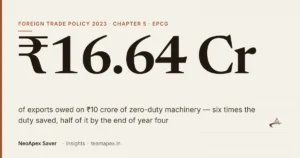
EPCG waives customs duty, IGST and cess on imported machinery against exports of six times the duty saved within six years, half by year four, above your three-year average. A Surat textile processor's ₹10 crore line, worked line by line.
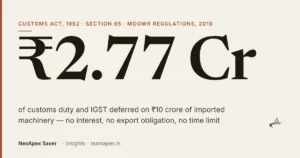
Under MOOWR your factory becomes a customs bonded warehouse: machinery and inputs enter with no duty at the port, and duty on inputs is paid only on India sales — never on exports. What is deferred, what it costs you in drawback and RoDTEP, an Ankleshwar example and the licence process.
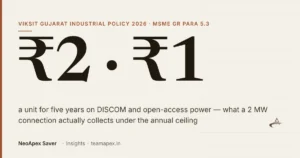
₹2 or ₹1 a unit for five years sounds simple. Run a 2 MW Ankleshwar connection through the component cap, the combined ceiling and the annual ceiling, and the figure that is actually paid is set by the capital subsidy, not the meter.
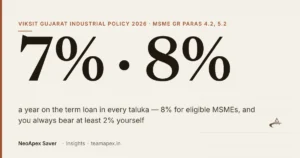
7% a year on the term loan sounds simple until the 2% floor, the 10%-of-EFCI cap and the annual ceiling are applied. A ₹6 crore loan at 9.5% in Sanand, worked year by year, with the lenders that qualify and the ones that do not.
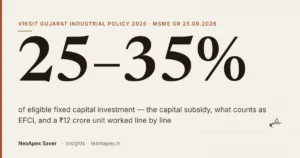
The rate is 25% or 35% of EFCI for MSMEs and 10% to 35% for Large units, but the base decides the rupees. What the GRs count, what they exclude, and a ₹12 crore Jhagadia unit worked line by line.
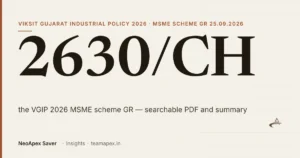
The full Viksit Gujarat Industrial Policy 2026 MSME scheme GR of 25 September 2026 as a searchable PDF, with every rate, ceiling and deadline summarised paragraph by paragraph.
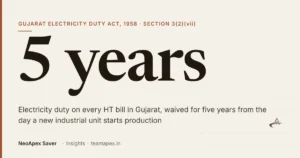
New industrial units in Gujarat pay no electricity duty for five years from first production — 15% on HT, 10% on LT, 60 paise a unit on DG power. Who qualifies, the 50% expansion test, what it is worth and how to get the CEICED certificate inside 90 days.
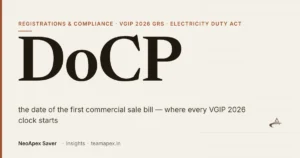
Both VGIP 2026 GRs define the date of commercial production as the first commercial sale bill of the project’s product; the Electricity Duty Act counts from the first day of manufacture. Every deadline that runs from each date, what must be in place before the first invoice, and how to evidence it.
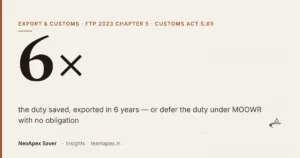
EPCG waives the duty on imported machinery against exports of six times the duty saved in six years; MOOWR defers it with no obligation and covers inputs too. Four questions, a side-by-side table and three Gujarat scenarios to decide which route fits.
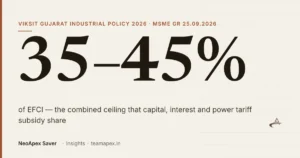
An MSME can combine all three VGIP 2026 subsidies — within a combined ceiling of 35% or 45% of EFCI and an annual ceiling of 7% or 9%, with no carry-forward. After capital subsidy, 2% of EFCI a year is left to fill from the loan or the power bill. Four worked units show who fills it.
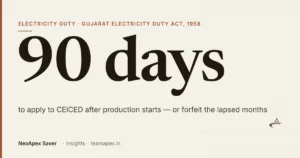
The five-year electricity duty exemption runs from the first day of production, and the application to CEICED is due within 90 days. File late and the lapsed months are forfeited under Rule 11(3) — ₹2.25 lakh a month on a ₹15 lakh HT bill. What to do if you are already late.
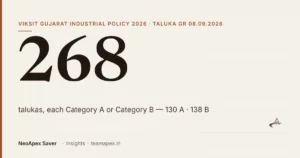
The full district-wise list from the taluka GR of 8 September 2026 — 130 Category A and 138 Category B talukas — and what the category changes in every VGIP 2026 subsidy table.
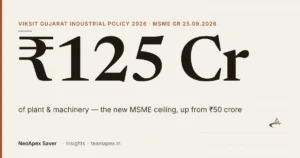
The VGIP 2026 MSME GR defines micro, small and medium enterprises by plant-and-machinery investment up to ₹2.5, ₹25 and ₹125 crore, with no turnover test. Who qualifies, and what it is worth.
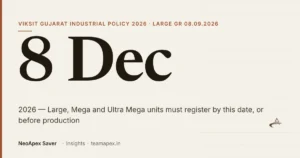
Registration under the VGIP 2026 Large GR is mandatory — before commercial production or by 8 December 2026, whichever is later. Who must file, the documents, and the PEC, FEC and quarterly-claim windows that follow.
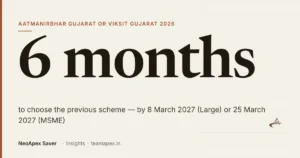
Units not in production before 1 June 2026 can still choose the Aatmanirbhar Gujarat Scheme — by 8 March 2027 (Large) or 25 March 2027 (MSMEs), with production by 4 October 2027. What the choice involves and how to decide.
Where to go next
The Viksit Gujarat Industrial Policy 2026 guideEvery rate, sector tier, taluka category and deadline, read from the three Government Resolutions.Read the guide →The subsidy calculatorPick your taluka, sector and investment; see the VGIP 2026 package, EPF, electricity duty and customs savings in one estimate.Run the numbers →A free eligibility checkSend your taluka, sector, investment and loan plan. We map every benefit and deadline, usually within one working day.Book the check →
Scheme guides