
Results from our scheme guides and articles. Can’t find it? Call +91 92748 61355.

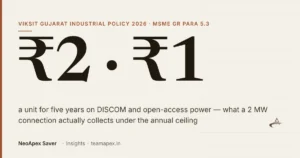
₹2 or ₹1 a unit for five years — the VGIP 2026 power tariff subsidy in Category A and Category B talukas

Power tariff subsidy Gujarat 2026: ₹2 or ₹1 a unit — what a 2 MW plant actually collects

₹2 or ₹1 a unit for five years sounds simple. Run a 2 MW Ankleshwar connection through the component cap, the combined ceiling and the annual ceiling, and the figure that is actually paid is set by the capital subsidy, not the meter.
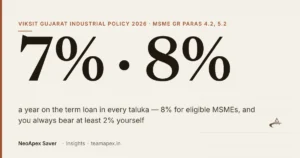
7% a year on the term loan, 8% for eligible MSMEs — the VGIP 2026 interest subsidy, with the unit always bearing at least 2%

Interest subsidy scheme Gujarat 2026: 7% a year, 8% for eligible MSMEs, 2% you bear

7% a year on the term loan sounds simple until the 2% floor, the 10%-of-EFCI cap and the annual ceiling are applied. A ₹6 crore loan at 9.5% in Sanand, worked year by year, with the lenders that qualify and the ones that do not.
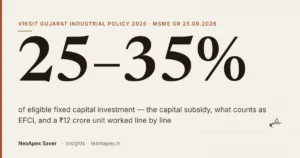
25–35% of eligible fixed capital investment — the VGIP 2026 capital subsidy rate for MSMEs in Category B and Category A talukas

Capital subsidy Gujarat 2026: 25% or 35% of EFCI — what counts, with a worked example

The rate is 25% or 35% of EFCI for MSMEs and 10% to 35% for Large units, but the base decides the rupees. What the GRs count, what they exclude, and a ₹12 crore Jhagadia unit worked line by line.
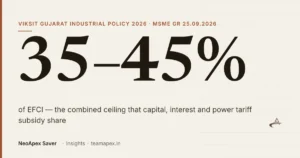
35–45% of EFCI — the combined ceiling that capital, interest and power tariff subsidy share under VGIP 2026

Capital, interest or power tariff? How the VGIP 2026 combined ceiling decides what an MSME collects

An MSME can combine all three VGIP 2026 subsidies — within a combined ceiling of 35% or 45% of EFCI and an annual ceiling of 7% or 9%, with no carry-forward. After capital subsidy, 2% of EFCI a year is left to fill from the loan or the power bill. Four worked units show who fills it.

Where to go next